<!-- The quote mentions messy and grinding and invisible labor, and i wonder how these have been evidenced in the text? (after reading the whole chapter, it seems it haven't been addressed) / no and we wouldn't put this quote -->
<!-- Chapter 3 - Reads well but lots of typos and references to fix. Needs finishing of course but like the focus, keep to the political ideas that inform systerserver and its naming.
P72 - Check second quote as is incomplete on pdf. I like the quotes, esp. McKinney one.
Throughout - consider the flow of subheadings - make a bit more distinctive, e.g. Infrastructure on p85 seems a bit bland, ditto Politics of Networks P79, even chapter title.
Drawings help to enliven the piece and bring clarity to the various elements that require the approcah described. I also like the examples of practice at the end, so the working practices are exemplified.
-->
<blockquote>
''"[T]echnologies are about relations with things we would like to relate to, but also things we'' ''don't want to be related to''<!-- COUNTER _ proposing our vpn is --- wanting to relate your static IP to us, but really this quote is more used as understanding in which networked practices you engage, or you don't COUNTER / DONE this is an interesting quote, but how these show in your IP investigation? I feel it is there, but may be when you write about your dependency, you can refer to this quote as a sign posting? -->''"'' Femke Snelting in Forms of Ongoingness, 2018</blockquote>
"[T]echnologies are about relations with things we would like to relate to, but also things we don't want to be related to." (Femke Snelting in Forms of Ongoingness, 2018)
==== intro ====
Feminist networking is a situated, transgressive and technopolitical practice that comprises more-than-human relations, hardware, wetware and software, as well as material, affective and protocological dimensions. Networking can be laborious, an act of care, of weilding solidarities, of sharing and of growing alliances. It is a community practice, a way of staying connected and connecting anew, of looking for and cherishing those critical connections which are always already more than technical -- even though technologies and mediatic infrastructures are often involved in making and maintaining them. Feminists have long recognized the power that digital networking technologies hold for forming translocal movements, mobilizing and sharing information quickly and without mediators. But when it comes to practices of appropriating technology, and coming closer to the machines in ways that are 'unfaithful' to their militaristic and extractivist origins (Haraway), we sense a lot of hesitation, fear and structural obstacles in our feminist queer circles.
This is why, as trans*hack, cyber feminists, some of us take inspiration from the tactics of ''Queercore: How To Punk A Revolution''. The documentary explores the rise of the queercore cultural and social movement in the mid-1980s, which channeled punk angst into a biting critique of societal homophobia. We introduce our feminist server's activities as a catalyst to push techno-feminism into existence and announce that we are here to stay. We set out to appropriate technology for and through our feminist networks, even amidst this current techno-fascist oppressive society.
====== Politics of networks ======
Systerserver, a feminist server project of almost two decades, has supported the Servpub project with their network infrastructure. The feminists involved in this project have configured their own infrastructure of two physical servers in the data room of [mur.at], an art association in Graz, Austria, which hosts a wide variety of art and cultural initiatives. The physical servers found this shelter through the networking of activists and artists during Eclectic Tech Carnival (/ETC), a self organized skill sharing gathering. Donna Meltzer and Gaba from Systerserver went to Graz to upgrade the servers' hardware in 2019. The first machine, installed and configured in 2005, is called Jean and was refurbished by ooooo in 2023 during their stay in Graz for the Traversal Network of Feminist Servers. The gathering was hosted by ESC, a local art gallery in Graz, which is affiliated with mur.at. <!-- COUNTER- WE REMOVED THE QUOTE- i really like this as i see how this might be resonated with the first quote in the text around invisible labors? (or messy, grinding?) just need to make explicit on things i feel --><!-- DIDNT-PROCESS_Seconding the comment here that more discussion of the labour relations around server maintenance and admin (radmin) would be useful here. How is that labour distributed and how does that feed into feminist networking practices? -->
Feminist networking involves two principles: '<nowiki/>''Making space for ourselves*' [x]'' and '<nowiki/>''choosing our* own dependencies'''[x]. These principles embraces the feminist politics of embodiment, situatedness and consensual decision making. Feminist networking is not constrained to digital technologies, or even to the ways in which the internet works. (see the 'other networks' publication). But when we are talking about the internet and its potential for feminist networking, we need to move away from thinking of it as something we 'use', away from the cloudy image of cyberspace serving the extension and intensification of the logistics of capital and data power [x]. Instead, we need to understand feminist networking in regard to the internet as a critical practice and theory at once: It means to insist on our vision of a feminist internet as a technopolitical and a collective way of becoming that we can 'co-create' and that involves bodies, materialities, networking skills and technological knowledges.
Both servers are running on Debian, which is a Linux based operating system and host together, Gitlab, a code repository, Peertube, a video and streaming platform, Mailman, mailinglist provider, Nextcloud, cloud storage and collective organisation, Mastodon providing a social networking platform<!-- DONE do you want to make explicit the chapter is written by systerserver (more because the use of 'our' sometimes is confusing - from which perspective, servpub or systerserver, and the relation to the project). and if you are written from the third person point of view, may be their? it depends on how you position this chapter i would say --><ref>Mastodon is a free and open-source software for microblogging. It operates within a federated network of independently managed servers that communicate using the ActivityPub protocol, allowing users to interact across different instances within the Fediverse</ref>, and Tinc, a virtual private network (VPN) software<!-- DONE Why Tinc rather than any other VPN software? What practical and ethical considerations went into choosing the other software on the server? -->. The VPN is the most recent addition, facilitating the need for home based and self hosted servers by our peers, <s>which in turn provide services for our feminist communities as well.</s> <!-- ? this is not our intention / ? --> Those server projects interweave into a feminist networking, an affective, socio-technical infrastructure, enabling the emergence of more trans-feminist groups and collectives <!-- DONE any examples? --> like actinomy (Bremen), leverburns (Amsterdam), caladona (Barcelona), brknhs (Berlin) to host their own infrastructuresb and be reachable by the public internet. Tinc was chosen as VPN software, mimicking the setup of Rosa which made a 'jumphole' through the VPN hub of the varia <ref>''varia'' is a space for developing collective approaches to everyday technology. As ''varia'' members, we maintain and facilitate a collective infrastructure from which we generate questions, opinions, modifications, help and action. We work with free software, organise events and collaborate in different constellations.</ref> server and was inspired by the network infrastructure of Xpub<ref>XPUB is the Master of Arts in Fine Art and Design: Experimental Publishing of the Piet Zwart Institute. XPUB focuses on the acts of making things public and creating publics in the age of post-digital networks.</ref> (Rotterdam, Piet Zwart Academy), as Mara, part of systerserver was writing together with Michael (Xpub), a Zine as a manual, how to setup a network for ambulant servers like rosa.<ref>https://psaroskalazines.gr/pdf/rosa_beta_25_jan_23.pdf</ref> The beta version of the zine was read, revisioned and updated by vo.ezn and deployed in the digital infrastructure of hackers and designers<ref>https://etherpad.hackersanddesigners.nl/p/hd_infrastructures-tinc</ref> (Amsterdam). Systerserver also replicated the configuration for the Servpub project.
One of the ways in which this technopolitical becoming materializes is through the practices of feminist servers such as Systerserver, which is the feminist server that channels some of our more current technofeminist practices. Systerserver is one of the oldest feminist servers, founded in 2005 in the context of the Gender Changer Academy and the Ecelectic Tech Carnival. (more on that?) As part of Systerserver we are well connected and co-dependent on other feminist server projects (anarchaserver, Maadix, leverburns, digiticalcare...) and autonomous tech collectives. Together we have a need to share ways of doing, tools & strategies ''to overcome/overthrow the monocultural, centralized oligopolic surveillance & technologies of control.'' We need to resist the matrix of domination. Stop the techno-facilitated exploitation and continuation of social and climatological injustice(s).[[File:Feminist internet.jpg|thumb]]
<!-- EUH - COMES LATER made explicit on servpub is using this, and how? -->A VPN software creates virtual private networks, connecting computers and machines that are not sharing the same physical location. In contrast to the internet, though, the network between these machines is concealed, thus called private, as it only exists between the trusted machines that are added to it. They cannot be seen by Internet providers or other bodies, who are not invited, nor authenticated in the private network. A VPN can also facilitate a public entry point to private machines, making them addressable and thus allowing them to become servers. Usually, devices are assigned an Internet Protocol (IP) address that changes periodically, thus called dynamic. A home or office router, also switches its public IP regularly, because the internet service provider (ISP) distributes IP address from a given pool, which can expire and trigger an IP address change, so called a lease time. ISP do this to manage their available addresses more efficiently and for minor security benefits.<ref>IP address lease times provide security benefits such as preventing persistent unauthorized use, reduce risks such as IP spoofing and theft, allow rapid response to misuse by removing compromised devices from the network.</ref> Finding a machine in the Internet, by remembering their IP, would be a challenging if not impossible thing to do. Thus, domain names such as https://wwww.servpub.net need to be mapped to an IP address, so when this domain name is visited, the browser can present the service or content hosted on that machine. Retaining this IP the same becomes important for mapping it to a domain name, therefore it's also known as fixed or static IP. The translation IP to domain names and back, happen with Domain Name Servers or DNS.<ref> a fun guide to what is a DNS, and computer networking in general, it's the zine ''Networking! Ack!'' by Julia Evans, 2017, available at https://jvns.ca/networking-zine.pdf</ref><!-- EUH - we switched the content - to first follow up on the previous chapter to than extrapolate on a wider discussion - These sections discussing IP addresses and VPNs feel a little disconnected from the preceding discussion on feminist networking. Why is a VPN core to this feminist networking practice? How does it link to ServPub and collective publishing? You can draw out the link to Woolf's work as outlined above. -->
[[File:Aicarmela-quote.png|thumb|Audrey Lorde cited by ai carmela]]
A feminist server is not just a technically facilitated node on the network, it is a place on the internet that we can inhabit and share with our intersectional, queer and feminist communities: A place where our data is hosted, the contents of our websites, where we are chatting, storing our stories and imaginaries and access the multiple online services we need to get organized (mailing lists, calendars, notes,...). This sense of a networked locality, of having an address which can be visited on the internet, is facilitated by the internet protocol (IP) which -- amongst other requirements -- allows a computer to become an addressable node. (Footnote: Servers are computers on a network, so called nodes, who are answering to the calls of nodes, that is to say to other computers on the network. These other computers take on the role of clients making calls such as the call to view a website, to provide a document, to send an email or to receive a video stream.)
So if a request is made to a domain name (for example https://wiki4print.servpub.net, which is serving our wiki) that is hosted on one of the trusted machines in the private network of Jean, the domain name request first reaches Jean, as the only server that has a public and static IP address in this network. On Jean, a web engine configuration software forwards the request to the private address of the machine, which hosts the wiki. The request is thus rerouted internally, meaning inside the concealed/private network, to the specific machine, which hosts the wiki4print website. This forwarding request is called a reverse proxy.
<!--DONE - moved image i think a diagram will be helpful here as well to help readers to follow --><!-- Seconding this, it's a little hard to conceptualise the flow of data. -->
However, serving, and becoming a server, is not just a technicality or a neutral relation between two or more computers. It is a technopolitical practice, that is tied to politics of protocols, of infrastructure, power, responsablility, dependencies, labour, knowledge, control, care, gender, dto practices of ressource extraction, exploitation, centralization, censorship etc. What are the politics of having an IP address, of being addressable on the internet? How can we subvert our dependencies on commerical services?
[[File:2-what-is-vpn.png|600x600px|frameless|What is a vpn]]
Who can become a server, who is being served? [x]
As feminist servers, we refuse to be served in a way that increases our dependencies on cis male dominated and commercial technologies.
Systersever has configured three of these virtual private networks to reach servers which have no public and static IP address, (VPN)<!-- EUH - intergare this sentence ?? - VPN and VLAN are different type of networking. VLAN is configured at the router and switch devices, and they are separating/segregating local subnets. In that setting, we can allow or block specific subnets from communicating with each other. -->: "internes", "alliances" and "systerserver". "Internes" is for Systerserver's internal network and it is used to reach the machine in Antwerp, which is making backup of our own servers( jean & adele) . "Alliances" is for facilitating a range of home-based server initiatives within our community, such as the Etherpad servers of leverburns which we use for technical documentation during our server maintenance work sessions, or allied communities such as Caladona and brknhouse that want to serve video content without having to commit to the expenses of acquiring a public, static IP address. There is also the network named “systerserver” which was our first attempt to install and configure Tinc for the publishing infrastructure of the ServPub project, making the raspberry-pies, which host the wiki4print and the servpub website accessible to the internet.[[File:Protocol_stack_hourglass.jpeg|300x300px|center|frameless|Ip protocol stack]]
Instead we need a room of our own and we need a ''‘connected room’ of our own''.* or ''a network of one's own''
Looking at the initial architecture of the Internet as a communication medium where a node can reach any other node, and the importance of a node to be authenticated by their address as a unique identifier, the current landscape has transformed to something quite different. Since the end of the 90s the development of the IPv6 protocol was conceived <ref>The first publication of the IPv6 protocol in a Request for Comments was in December 1998, accessed on September 20th, 2025, https://www.rfc-editor.org/rfc/rfc2460.txt</ref> for enabling larger addresses, mitigating the depletion of IPv4 addresses, whose notation hasn't been long enough to cover the proliferation of devices, but also allowing more security and various methods of sending and receiving messages. The encryption protocol IPsec, introduced around the mid-1990s, provided an end-to-end security at the IP layer, authenticating and encrypting each IP packet in data traffic. It was compatible with IPv4 to ensure encryption, however it requires extra software installation and configuration steps, but it was incorporated as a core component of IPv6.<ref> Besides IPv6 protocol being a secure protocol with extra authentication and privacy, it also has support for unicast, multicast, anycast. See more at ''Internetworking with TCP/IP'', Vol. 2 by Douglas E. Comer and David L. Stevens, published by Englewood Cliffs, N.J. : Prentice Hall, 1998, accessed on September 20th, 2025, https://archive.org/details/internetworking000come</ref> Therefore, while internet communication over the web, provides encryption with the secure HTTPS certificates, other internet connections, e.g files syncing over two machines, require encryption configurations and/or VPN tunnels.<ref>While HTTPS is a way to secure traffic over the internet, it is distinguished from IPSec in that IPSec secures all data traffic within an IP network, suitable for site-to-site connectivity. HTTPS, the secure version of HTTP, using TLS certificates, secures individual web sessions. The authentication with a TLS certificate relies on name ownership, and not on the integrity of the server's IP address. This fact enables CDNs to cache content and serve in place of the origin server, which contributes to the centralisation of content distribution over the web. https://gcore.com/learning/tls-on-cdn
<ref>referring to the paranodal periodic publication and series of events and worksessions in rotterdam revisting of Virgina Woolf's classic essay.</ref>
Problem of data literatcy:
More about how TLS works https://www.bacloud.com/en/blog/190/ssl-for-ip-lets-encrypt-now-supports-tlsorssl-certificates-for-ip-addresses.html</ref> One may argue whether the embedded encryption within the IP packet for every node on the Internet, it is a civil right that the industry and states' surveillance would rather avoid.<!-- another question would be: how this VPN becomes feminist networking? (i just tried to link to your title, and the thinking of networking, and how this becomes that...) may be centralized this VPN and IP as the main object of study, and to show how this is feminist networking, and explain through your quote like messy, invisible labors, etc...choosing dependencices... -->
Besides from these roles we need to encourage “data infrastructure literacy” for the ability to account for, intervene around and participate in the wider socio-technical infrastructures in which data is created, stored and analyzed. Our intent is to make space for collective inquiry, experimentation, imagination and intervention around data. Data as in binary information, suitable for processing by computers, recognizing it's intrinsic (human)labour conditions, maintenance and hence care. In becoming more literate, we cultivate our sensibilities around data politics and as well engage a wider public with digital data infrastructures. <ref> https://journals.sagepub.com/doi/10.1177/2053951718786316</ref>
Up until now, the transition to the IPv6 protocol has been overshadowed by the tech industry's monetary need for scaling. Storage and computing became inexpensive, which saw the development of serving content through intermediaries, that are located closer to users network access, and which can cache content, known as Content Distribution Networks (CDNs) <!-- very strange sentences, they need to be split in shorter understandable sentences. -->. Those providers serve most of Internet content and have minimized the factor of geographic distance from the network, as well as eliminating the need for unique addresses assigned to servers and clients for reaching each other. They have, nonetheless, utterly centralized the Internet. Moreover, the lower motivation for business to offer and maintain both IPv4 and IPv6 network stack, as other technologies such as address-sharing<ref>See for example routing via Network Address Translation (NAT), https://en.wikipedia.org/wiki/Network_address_translation</ref> and CDNs have fixed the issue of handling the scarcity of IP addresses,<ref>Geoff Huston, ''The IPv6 transition'', 2024, accessed on September 20th, 2025 at https://blog.apnic.net/2024/10/22/the-ipv6-transition/</ref> have contributed to a decreased pace in advancement of technology that supports IPv6. This has resulted in internet service providers (ISPs) charging higher prices for a reduced number of IPv4 addresses and in some cases, legacy IP blocks of addresses can even be sold in the grey market, <!-- the politics is interesting, just want to hear more how this impact your decision of supporting communities, providing VPN services, and may be something you see the need investigate big tech decisions? (i think what i am doing is want to push further the implication of the values of feminist networking/systerserver or how servpub allows you to see and investigate this?) -->because those blocks were not regulated by any regional internet registry system since they were allocated before those registries came to existence.<ref>The African continent registry AFRINIC have been under scrutiny due to organizational and legal problems. In 2019, 4.1 million IPv4 addresses part of unused legacy IP blocks, were sold on the grey market. Accessed online on 25 July 2025 https://en.wikipedia.org/wiki/AFRINIC.</ref>
For this reason we need to make servers visible and physical as a crucial/critical space,
During the translation of the VPN manuals Tunnel Up/ Tunnel Down<ref>Tunnel Up/ Tunnel Down, Mara Karagianni, a self-published zine about what is a VPN and its various uses and technologies, 2019, https://psaroskalazines.gr/pdf/fanzine-VPN-screen-en.pdf.</ref> the Chinese artist and translator Biyi Wen pointed to the art research project "A Tour of Suspended Handshakes". In this project, artist Cheng Guo physically visits some nodes of China’s Great Firewall. <!-- Maybe some discussion of Tor and other IP-obfuscating technologies is appropriate here? The work of Alison Macrina of the Library Freedom Project provides a good example of using Tor in an activist (and feminist) context. -->Using network diagnostic tools, the artist identified the geolocations mapped to IP addresses of these critical gateways, based on data published by other researchers. At times, these geolocations correspond to scientific and academic centres, which seem like plausible sites for gateway infrastructure. Other times, they lead to desolate locations with no apparent technological presence. While Guo acknowledges that some gateways may be hidden or disguised - for example, antennas camouflaged as lamp posts - the primary reason for these discrepancies lies in the redistribution and subnetting of IP addresses, as well as their resale. These factors make it difficult to pinpoint exact geographical locations. Additionally, online IP geolocation tools provide coordinates in the WGS-84 system (the global GPS standard), whereas locations in China must be converted to GCJ-02 (an encrypted Chinese standard). This further complicates geographic identification, as mapping activities have been illegal in mainland China since 2002.<ref>https://en.wikipedia.org/wiki/Restrictions_on_geographic_data_in_China</ref><!-- IS ANOTHER EXEMPLE OF VPN USE
By making infrastructures visible with the aid of drawings, diagrams, manuals, metaphors, performances, gatherings, systerserver traverses technical knowledge with an aim to de-cloud (Hilfling Ritasdatter, Gansing, 2024) our data, and redistribute our networks of machines and humans/species.
ok you bring in the chinese firewall as another form of using VPN (also in artistic practice), but may be need to connect more your central theme. How does this chinese firewall adds to what you want to say around feminist networking (as not just something like the application of VPN?) -->
A connected room, network of one's own, with allies as co-dependencies, attributes collectivities interacting as radical references which evades hierarchies of cognitive capital based on individuals and underlines the collective efforts to resist within the hegemonic technological paradigm. <ref> https://www.roots-routes.org/hacking-maintenance-with-care-reflections-on-the-self-administered-survival-of-digital-solidarity-networks-by-erica-gargaglione/ </ref>
In the case of the Great Firewall, the combination of IP redistribution and encrypted coordinates obscures the true locations of its gateways, rendering the firewall a nebulous and elusive system. We would like to argue that for mobile (ambulant) servers, geolocating the private servers concealed behind the private network -beyond the main public-facing nodes - remains a challenge. However, unlike the Great Firewall, the mobility of such servers is not enforced through a top-down governmental control. The desire to be addressable from our home based infrastructure through a network-sharing of tunnels and reverse proxies through trusted public nodes,<ref>Dynamic DNS is another option for when your ISP changes your home network's IP address.It is a commercial service that allows you also to use a fixed address for your home network. You can often set up DDNS on your router. Self-hosted website or online resource will be redirected over commercial nodes maintained by companies; companies which are often known for data-exploitation, acts of censorship and compliance with states agencies in cases of political prosecution.</ref> Community infrastructures in this case, bring about the potential to circumvent state and capitalist surveillance, such as commercial centralised CDNs, institutional and business firewalls, and turn this imposed scarcity into a solidarity action.<!-- it is more a signposting - perhaps link back to your notion of feminist networking? -->
--
====== '''Infrastructure as digital litteracy''' ======<!-- DONE- why do we need another big words of data activism? how this relates to feminist networking? i understand that following data is a way of addressing politics of networking, but i think i do not get why need to situate in a new context of data activism. It becomes unclear of the network, networking, data, infrastructure. what's the difference between data infrastructure and networked infrastructure, or networks as infrastructure, there are many contested terms used (which is more my concern though) -->
[[File:Port443-ssl.jpg|thumb]]
Being part of the internet, or internets<ref>Networks with an Attitude - https://constantvzw.org/sponge/s/?u=https://www.constantvzw.org/site/-Networks-with-an-Attitude-.html</ref>, creating and maintaining our own networked infrastructures involves an understanding of the technicalities and politics of IP addresses, networks, routing and subnetting, and of an economy of scarcity and institutional and corporate control. One way of addressing the politics of networking and of relating with technology is by 'following the data'. Data is not just an informational unit or a technicality, it is how we relate to computers, both on a supra- or infra-individual level but also as something that can be incredibly personal and intimate. We need to keep asking 'Where is the data?' (as in binary information). We need to develop technical awareness and accountability in how we participate and are complicit in the existing infrastructures in which our data is created, stored/sold and analyzed. <!-- SEEMS CLEAR - we introduced in-grid in setting up a server,
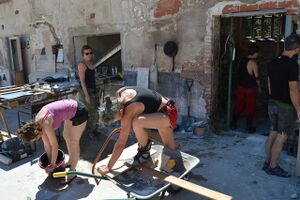
Public interface anarchaserver in calafou: https://zoiahorn.anarchaserver.org/physical-process/ [[File:Server-wiki-act5.png|thumb]]
how do you see this relates to servpub? or how you do things on following data for the servpub project? -->In becoming more engaged, we cultivate our sensibilities around data and infrastructure politics.<ref>https://journals.sagepub.com/doi/10.1177/2053951718786316</ref>
By making infrastructures visible with the aid of drawings, diagrams, manuals, metaphors, performances and gatherings, Systerserver traverses technical knowledge with an aim to de-cloud (Hilfling Ritasdatter, Gansing, 2024) data and redistribute networks of machines and humans/species.<!-- SEE EXEMPLES ? - More on how Systerserver is doing that. Are you making infrastructures visible through events, community engagement, online resources or documentation? --> We have the potential to exchange knowledge, and to maintain and care for a space together in a non-hierarchical and non-meritocratic way<ref>https://creatingcommons.zhdk.ch/wp-content/uploads/2020/06/Transcript-Femkespider.pdf</ref> - often referred to as “feminist pedagogies” in the introductions and talks about our praxis. It centers around developing tactics and approaches related to content, welcoming various and diverse experiences located in the places where we physically meet, and cultivating learning by accepting life experiences, recognizing that knowledge is socially constructed.
Are you being served ? s performative event developed by ooooo which took place during The Feminist Server Summit, organized by constantvzw in brussels https://areyoubeingserved.constantvzw.org/Home_server.xhtml Home is a Server is about mimicking computer functioning through human energy and towards a human goal (eating the pancake instead of just publishing its recipe online), transforming ourselves into CPU, data, kernel, hard drive, booting, rebooting, getting into Kernel Panick and finally managing to get through the difficulties of sending data out, making a wiki that eventually achieves the very physical process of making pancakes for the group during the afternoon, 12–15 December 2013
<!-- I like the examples of events here. I think they could be moved up in the text to serve as examples of the history and genealogy of feminist networking and Systerserver's practice. Thread them through the introductory section as examples of what you're discussing. -->
===== politics of networks =====
<blockquote>
Being part of the Internet, or internets, creating and mainting our own networked infrastructures involves an understanding of the technicalities and politics of IP address, local, public, private and virtual networks, routing and subnetting, an economy of scarcity, institutional and corporate control.
[[File:Root-prepare.jpg|300px|sudo apt upgrade]]
Systerserver infrastructure is sheltered in the data room of mur.at, a cultural association which enables the hosting of a wide variety of art and cultural initiatives in a (shared) virtual server, along with Systerserver’s two physical servers. Donna Meltzer and Gaba from Systerserver went to install the most recent hardware in 2019 . The server is called Adele. The older machine was installed and configured in 2005 and is called Jean. Both are running on Debian, which is a Linux based operating system, with different services on each machine. Jean hosts a social network platform, a mastodon instance for our wider feminist communities, and tinc, a VPN software. Mastodon is a free and open-source software for microblogging. It operates within a federated network of independently managed servers that communicate using the ActivityPub protocol, allowing users to interact across different instances within the Fediverse. Tinc is a VPN tunneling software. It creates virtual private network(s), enabling computers and machines to connect to each other, even if these machines are not servers with a public address. The network is hidden, thus called private, as it only exists between the machines that are added to it.
[[File:root-1.jpg|300px|root in public interface anarchaserver]]
[[File:Port443-ssl.jpg|300px|port 443]]
A VPN can also facilitate as a public entry point to these machines, allowing them to become servers. So if a request is made to a domain name, which e.g, is serving a wiki, hosted in one of these machines hidden within the private network of Jean, the domain name request is first reaching Jean, the only public address in this network. On Jean, a web engine configuration software is resolving the domain and mapping it to the private address of the machine, which hosts the wiki. The request is thus rerouted internally, meaning inside the hidden network to the specific machine <ref> See also the networking introduction of the art project ''A Traversal Network of Feminist Servers'', which allowed '''rosa''', the project's mobile server to travel to places: the Hub, p.9, accessed on 24 July 2025, https://atnofs.constantvzw.org/ATNOFS-screen.pdf. However systerserver as a techno-feminist collective don't prescribe to the idea of originality and individuals' accreditation to technicalities that have a long history of software development and implementations in various contextes, we cite the reference as another example of using VPN in artistic infrastructural practice.</ref>
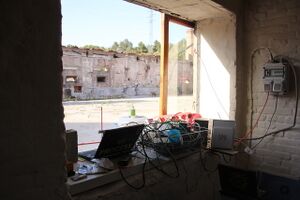
-->The importance of these offline-online entanglements manifested in the renovation of part of a building in an eco-industrial colony in the mountains near Barcelona, which hosted the first THF<!-- what is this? -->. The room onsite was transformed into a physical public interface <!-- why add the term interface there? why not just a public room? may be my question is what's the specificity of the interface? -->for the practices around the feminist server: anarchaserver.org<ref>This link https://zoiahorn.anarchaserver.org/physical-process/ is hosted on the anarchaserver server. Anarchaserver is an allied […]</ref><!-- as this anarchaserver is quite crucial to systerserver history and the currently alliance, may be worth expanding the details in the footnote, and now the footnote is incomplete --> Open for visitors, it was used during system administrative work sessions, and for gatherings, sonic improvisations and radio. The door, window, ceilings and multi-levels were analogous to the functionalities of a server’s hardware-software counterparts (ports, encryption, including a repository... and even a firewall). It also had a bed,where somebody could sleep, rest and reside in analogy with the Living Data container, which hosts [https://alexandria.anarchaserver.org/index.php/Main_Page ALEXANDRIA] for Wiki documenting and [https://zoiahorn.anarchaserver.org/ ZOIA HORN] for multi-site blogging.<!-- what do you want to say with this highlight paragraph? is this an example of affective infrastructure that you mentioned in the last section? or how that relates or transition to the next one called politics of networks? --></blockquote>
Systersever has configured three of these private networks, distinguishing between "internes" and "alliances". The first is for Systerserver physical servers in mur.at to reach a backup server in Antwerp, which has no public address. The latter is for facilitating a range of home based server initiatives within our community, e.g, the etherpad servers of leverburns which we use for technical documentation during our server maintenance worksessions. Or allied communities, e.g, Caladona that want to serve content without having to commit to the high costs of acquiring a public address. There is also the network named “systerserver” which was our first attempt to install and configure Tinc for the publishing infrastructure of the ServPub project, making the raspberry-pies wiki and website accessible as servers. Home based servers are assigned with dynamic addresses that change periodically. A home router switches its public IP regularly, thus called dynamic IP addresses, because the internet service provider (ISP) temporarily assigns an IP address from a given pool, called also a lease time, that can expire and trigger an IP address change. They do this to manage their available addresses more efficiently and for minor security benefits. The drawback of this, is that a home router cannot be assigned a domain name, since domain names need to be mapped to what we call a static of fixed IP address in order to be translatable to a unique machine’s service or content.
Hence for home based servers to be accessible in the Internet they need a static IP address. With the creation of the Tinc networks, as we mentioned above, home based machines can become servers since they can be accessed via the IP of jean which has a fixed IP, assigned by the networking of mur.at. Tinc (and other VPN) tunnels operate within private networks, usually in the ranges of 10.0.0.0 pool, and the machines 'invited' inside these tunnels can connect to each other. The machine with the public IP, or the public node, as we call it within the private network, provides the web engine configutation software – nginx, apache being the most popular and FLOSS options, and those that we work with in Systerserver infrastructure – for forwarding traffic requests, which is also called a reverse proxy. Proxy because Jean servers as the proxy to reach a hidden (private) machine, and reverse, because the hidden machine can respond back to the request by serving its content to the computer who requested it. This is therefore the other distinct feature of a server, the ability to receive and send data over the network, while a computer who is not serving, known as the client, and which is the typical case of working with our computers from home, browsing the internet, and being able to request content, but not being allowed from our home router to send or serve content outside our home network.
A VPN software and a reverse proxy configuration is a tactical dependency to avoid the costs for a static IP address, therefore overcoming the shortage of IPv4. Or to avoid censorship and institutional control over the content of a server, since it remains hidden from the public network provided by the ISP. It also facilitates the mobility of home based servers, and reinforcing trusted networks by enabling hidden localities – the actual IP address of the private server is not known, but to the public node. Who is the public node, hence becomes a political dependency. And the legalities that govern that said public node become crucial depending on the content being served.
<blockquote>
We have to keep in mind that adding new servers to our Tinc network(s), requires more bandwidth traffic, and hence material resources from the dataroom in mur.at.
[[File:server-wiki-act5.png|thumb|Home is a server]]
"Home is server" is a performative event which took place during The Feminist Server Summit, 12–15 December 2013 ,organised by constantvzw in brussels. "Home is a Server"<!-- should the title be "Home is server" or "Home is a server" ? --> is about collectively embodying a computer with some props, a script, CPU, RAM, watchdogs, triggering data, ports, kernels, hard drives. Together we follow the data flow while we install a server, send data in/out, install a wiki and publish a recipie for pancakes which we bake and eat together. <!-- things unfold a bit here...may be move this upfront? -->
</blockquote>
===== choose your dependencies =====
<blockquote>
An alternative for when your ISP changes your home network's IP address, would be Dynamic DNS, which is a useful service that allows you also to use a fixed and memorable address for your home network. You can often set up DDNS on your router. You can also run a DDNS client on one of your servers.
"Humming birds" is a performative event which took place in 360 degrees of proximity in Faqladen (Berlin) & caledona (Barcelona). Using basic feminist federation by sociometric exercises and voicing techniques we explore the Fediverse, all talking the same protocol ActivityPub.
</blockquote>
<!-- not image here, is it an example of data activism? -->
<!-- a general comment is how do these two images relate to data and IP? which as a reader i am in this headspace that follow your flow..but seems the image title doesn't help me to know more in this area. (or if this is not your intention, can you show me why these images are here?) -->
The Cryptodance is a performative event to familiarise ourselves with different modes of encryption.<!-- EUH
these are just exemples of how to learn differently about complex digital notions and technical terms
THIS SEEMS MORE INFORMATIVE /MAYBE IN SEORATE DESIGN STYLE [[File:Protocol stack hourglass.jpeg|thumb|Protocol stack]]
why we move to encryption here? (i know is part of VPN thing but the readers might not know and the relevance)
i think i see the desire of self host here,that's why i suggest the title as desiring your own infrastructure..just a thought...
also the article ends with this grey box and screenshot image, are you missing a final paragraph or something? -> this could be recap on the things you mention and how to explicate the notion of feminist networking? -->. Whilst collectively embodying issues of security, privacy, safety and surveillance, we converge on a technopolitical urgency for sovereignty and a desire for affinities with the body/machine ~ living organisms/algorithms. Cryptodance was developed in August 2016 during the preparations for [https://femhack.noblogs.org/post/2016/05/31/thf2016-en/ THF 2016!], by a small international constellation of choreographers, hackers and dancers. They met, discussed and wrote a choreography combining dance annotations, crypto techniques and careful somatic tactics. Goldjian and bolwerK started plotting the Cryptodance project during a Ministry of Hacking (hosted by esc in Graz, Austria), where they formed a joint(ad)venture of the Department of Waves and Shadow and the Department of Care and Wonder.
</blockquote><blockquote>''"Activist infrastructures are where the messy, grinding, generally invisible labor of 'doing feminism' takes place."'' Cait McKinney in Information Activism - A Queer History of Lesbian Media, 2020
</blockquote>
====== lan/wan/van ======
To understand somehow more the private and public IP’s and networks, we can look at them from their naming conventions. LAN is an abbreviation for LOCAL AREA NETWORK, and the reserved addresses for these networks are either 192.x.x.x, 169.x.x.x (DHCP) and 172.x.x.x. These addresses are distributed within one room, building that has a router. The router that broadcasts the WiFi or provides ethernet cable connections is the interface between the local network inside the room, and the WAN (WIDER ARE NETWORK), basically the Internet.
The addresses 10.x.x.x are reserved for the private networks, that are also called virtual. Since Virtual Private Networks are more complex to comprehend. Let's introduce a little bit of their history, hoping that it will illustrate their purposes and functions more.
// WE WOULD STOP HERE AND TAKE ALL OF THIS OUT // I tdoesn't make sense servpub isn't a feminist networking project -
====== Feminist networking<!-- This introductory section perhaps needs to start with more context on the social networking being discussed here as well as introducing how this will link to network infrastructure later in the chapter. Perhaps some added context around the masculine and militarised origins of the internet and computer culture in general. Generally the terminology around IP addresses and VPNs should be introduced earlier so the chapter feels more cohesive. -->======
Feminist networking is a situated technopolitical practice that engages us in more-than-human relations with hardware, wetware and software. Networks are material, and interfaces to affective relations through protocols. Networking can be in that sense laborious, an act of care, of wielding solidarities, of sharing and of growing alliances, recognizing our precarities, identities and collective oppressions. It is a community practice, a way of staying connected and connecting anew, of looking for and cherishing those critical connections<ref>Following a quote from Grace Lee Hoggs on connectedness and activism which puts 'critical connections' over 'critical mass' after an idea by Margaret Wheatly. (Boggs, Kurashige, and Glover. 2012, p. 50)</ref> which are always already more than technical. Feminists have long recognized the power that communication technologies hold for forming translocal movements,<ref>McKinney describes how lesbians built newsletter networks for fostering lesbian culture in the 70s till mid 90's, in chapter one ''The Internet that Lesbians Built'', Cait McKinney, ''Information Activism - A Queer History of Lesbian Media'', Duke University Press, 2020</ref> mobilising and sharing information without moderators.<ref>See the interview with Donna, Aileen, Anne and Helen from Systerserver, 2025. (to be published at https://systerserver.net)</ref> But when it comes to practices of appropriating technology, and coming closer to the machines<ref>Haraway, Cyborg Manifesto p. 10. The phrase 'close to the machine' is borrowed from Ellen Ullman who has written about her life as a female software developer in the early era of the personal computer.</ref> we sense hesitation, fear and structural obstacles in society and queer communities. As with Systerserver <ref>Systerserver is durational feminist server project, founded in 2005 in the context of the Gender Changer Academy and the Ecelectic Tech Carnival. (expand more on that? maybe put the part about the physical machines and mur.at here.)</ref> being part of this wider trans*hack<!-- any ref link? -->, cyberfeminist network, we dare to introduce our server's activities as a catalyst to push techno-feminism into existence and announce that we are here to stay.<!-- what this means by here to stay?
WE WILL NEVER BEEN FORGOTTEN? WE WILL NEVER BE HIDDEN? WE ARE HERE AND WE WILL STAY HERE --><ref>''Queercore: How To Punk A Revolution''. The documentary explores the rise of the queercore cultural and social movement in the mid-1980s. Although the movement started with only a handful of outsiders ('too queer for punk culture and too punk for the queers'), they persisted in channelling punk angst into a biting critique of societal homophobia</ref> We set out to appropriate and develop technologies for and with our network and communities, critically addressing the oppression of a techno-fascist system.<!-- are there any thing related to the servpub project in this regards?for example, how this applies to your VPN service strategies? --> Together we have a need to share ways of doing, tools and strategies to overcome and overthrow the monocultural, centralised oligopolic technologies of surveillance and control''.'' We need to resist the matrix of domination. Stop the techno-facilitated exploitation and continuation of social and climate injustice(s). <!-- there are different big terms or claims in the first paragraph, perhaps can introduce more the context? -->
====== history and topology of VPN ======
Feminist networking prompts us into making space for ourselves<!-- yes include picture would be good, and how that apply in servpub? (see footnote) -->'''<ref>This is on one of the slides ''of the presentation --> could include that as a picture.'' </ref> '''''and'' choosing our own dependencies''<ref>After a ''phrase from'' the first Feminist Server manifesto: " A feminist server… is autonomous in the sense that she decides for her own dependencies." https://areyoubeingserved.constantvzw.org/Summit_afterlife.xhtml</ref>''. These prompts embrace the feminist politics of embodiment, situatedness and consensual decision making. Feminist networking is not constrained to digital technologies, or even to the particular 'network of networks' aka the internet.<ref>Check out the 'other networks' projekt and anthology by Lori Emerson, https://shop.mexicansummer.com/merch/495898-lori-emerson-other-networks-a-radical-technology-sourcebook</ref> But when we are talking about the internet and its potential for feminist networking, we need to move away from thinking of it as something 'given' that we might 'use'. We need to shift away from the cloudy image of cyberspace serving the extension and intensification of capital, governance and data power.<ref>Metahaven, Daniel van der Velden, and Vinca Kruk. 2012. ‘Captives of the Cloud: Part I’. ''E-Flux'' 37.</ref>
After the WWW and http protocol, the question of secure connections became urgent as the ability to connect beyond institutional networks became wider.
AT&T Bell Laboratories developed an IP Encryption Protocol (SwIPe), implementing encryption in the IP layer. This innovation had a significant influence on the development of IPsec, an encryption protocol that remains in widespread use today.
"IPsec, introduced around the mid-1990s, provided end-to-end security at the IP layer, authenticating and encrypting each IP packet in data traffic.
<!-- is servpub a feminist networking? -->Feminist networking is praxis <ref>''The Human Condition'', Hannah Arendt</ref>: it means collective vision for a feminist Internet<ref>Including the principles of a feminist internet</ref> <!-- the ref - do you have link? year? -->as a technopolitical way of becoming servers, that we can 'co-create', involving our bodies, materialities, networking skills and knowledges. <!-- how? can this relates to servpub? or your involvement in servpub? --><!-- To add to the comments about relating to ServPub, how is feminist networking instantiated through publishing? What is it about collective and collaborative publishing that allows it to enable feminist networking? -->
Notably, IPsec was compatible with IPv4 and later incorporated as a core component of IPv6. This technology set the stage for modern VPN methodologies."
By end of 90s Microsoft worked towards implementing a secure tunnel protocol, creating a virtual data tunnel to ensure more secure data transmission over the web. The encryption methods used in the PPPP was vulnerable to advanced cryptographic attacks. the MPPE (Microsoft Point-to-Point Encryption), only offers up to 128-bit keys which have been deemed insufficient for protecting against advanced threats. Later together with Cisco, they developed another protocol, the L2TP, for serving multiple types of internet traffic.
====== Networks as infrastructures of one's own ======<!-- the title is quite complex..as you had feminist networking, and now networks as infrastructure. since the section is about desire, how about "Desiring our own infrastructure" ? just a thought also may be worth thinking networks, network, networking, all these terms - and stick with 1 so that you can keep unfolding the complexity of your choice of 'networking' --><!-- Or 'A Server of One's Own'? 'A Network of One's Own'? -->
A feminist server goes beyond a technically facilitated node in the network, it is an (online) space that we enter "as inhabitants, to which we make contributions, nurturing a safe space and a place for expression and experimentation, a place for taking a role in hacking heteronormativity and patriarchy."<ref>Spideralex in Forms of Ongoingness</ref> A server is a place on the internet that we can share with our intersectional, queer and feminist communities, a place where our data and the contents of our websites are hosted, where we are chatting, storing stories and imaginaries, and accessing the tools we need to get organized (mailing lists, calendars, etherpads) Hence, serving, and becoming a server is not just a neutral relation between two or more computers.<ref>https://www.roots-routes.org/hacking-maintenance-with-care-reflections-on-the-self-administered-survival-of-digital-solidarity-networks-by-erica-gargaglione/ [client/server nor user/developper]</ref><!-- I love linking the word 'server' to the verb 'serving' and would like to see that community-focused idea of serving drawn out a bit more in the chapter. --> It is tied to politics of protocols, of infrastructure capacity and power, responsibilities, dependencies, labour, knowledge, and control. What are the politics of self-hosting and being addressable on the internet, by having an IP address of one's own?<!-- this IP term and context needs to introduce before. It comes in the picture suddenly. (and need explain why specifically focus on IP) --> How can we emancipate ourselves from the techno-fascist platforms and content service providers? Which layer of the internet protocol stack we shall intervene? Who can become a server, who is being served?<ref>Linking to the Feminist Server Summit</ref>
"L2TP (Layer 2 Tunneling Protocol) works by encapsulating data packets within a tunnel over a network. Since the protocol does not inherently encrypt data, it relies on IPsec (Internet Protocol Security) for confidentiality, integrity, and authentication of the data packets traversing the tunnel."
As feminist servers, we refuse to be served in networks that increase our dependencies on cis male dominated and neoliberal technologies.<!-- Such as? An example would help communicate this point. --> The spacial vocabulary around having a place or 'a room of one's own' on the internet is therefore important, referencing historic feminist struggles for agency, and safe/r off- and online spaces for uninterrupted time together to imagine technological praxis otherwise.
A later tunneling protocol is the openVPN, which has been designed as a more flexible protocol allowing port configuration, and more security.
In her essay, ''A Room of One's Own'', Woolf addresses the need for women to escape from the societal pressure of fulfilling their assigned roles as care-givers, house wives and servants, and become creative without being affected by society's expectations of moral chastity on women. By earning our own means, we can claim the privilege of not sharing a room, so that we can think and write without constant interruptions from the gender based assigned duties. For many people in the feminist movement, the fight to become our own persons, with our own spaces, our own devices and ways of accessing the internet, is still ongoing in the face of intersecting, economic oppression and gender based societal roles and constraints. This can sometimes look like a practice of withdrawal, of temporarily locking the door behind oneself or of creating separatist spaces with peers whose experiences are similar to our own. Yet importantly, insisting on this room of one's own - not unlike the room of the woman who writes on the back of and in reference to other women authors (a room full of books one can presume) - is also insisting on connecting with others, of making critical connections.<ref>Boggs, Grace Lee, Scott Kurashige, and Danny Glover. 2012. ''The next American Revolution: Sustainable Activism for the Twenty-First Century''. 2nd ed. Berkeley: University of California Press.</ref> In terms of feminist servers, the server thus becomes a 'connected room' or even 'infrastructures of one's own', characterized by the tension between the need for self-determination and the promiscuous and contagious practices of networking and making contact with others. These practices inherently surpass strong notions of the individual 'self', facilitating instead a collective and heterogeneous search for empowerment, and partake in creating the conditions for networked socialities and solidarities. They transform to a connected room,<ref>See also spideralex, referencing Remedios Zafra's book "A Connected Room of One’s Own" in Forms of Ongoingness, Interview with Femke Snelting and spideralex, by Cornelia Sollfrank.</ref> a network of one's own, with allies as co-dependencies, attributing each other(s), interacting as radical references<ref>Inspiration for this article: [https://wiki4print.servpub.net/index.php?title=Chapter_5b:_Distribution Chapter_5b:_Distribution]</ref> to evade hierarchies of cognitive capital, which are crucial for sustaining collective efforts of resistance against capitalistic logics of knowledge and cultural production.
Tinc protocol follows here...
Furthermore, the metaphor of one's own room highlights the ways in which bodies need to be accommodated in the practices of feminist servers and networking. These bodies incorporate our data bodies<ref>https://www.apc.org/en/pubs/consent-our-data-bodies-lessons-feminist-theories-enforce-data-protection</ref> but also the ways in which we show up in gatherings and places outside the digital networks. Self-organised gatherings such as the eclectic tech carnival (/etc)<ref>https://monoskop.org/Eclectic_Tech_Carnival</ref> or the trans hack feminist convergence (THF),<ref>https://alexandria.anarchaserver.org/index.php/Main_Page#TransHackFeminist_Convergence</ref> and feminist hacklabs such as marialabs, fluid.space, mz balathazar’s laboratory, t_cyberhol, as well as (art) residencies or other larger gatherings (Global gathering, Privacycamp, OFFDEM, CCC) have been crucially nurturing and fueling the desires for our own servers. These are moments where feminist networking can materialise into feminist servers and affective infrastructures.<ref>nate wessalowski, Mara Karagianni, ''From Feminists Servers to Feminist Federation'', Vol. 12 No. 1 (2023): Minor Tech, 2023, https://doi.org/10.7146/aprja.v12i1.140450</ref><!-- This history and genealogy of feminist networking is good and perhaps could be expanded to provide a fuller picture of how feminist networking has been instantiated through activist groups. -->
While https is another way to secure traffic over the internet, it is distingue from IPSec in that IPsec secures all data traffic within an IP network, suitable for site-to-site connectivity. HTTPS, the secure version of HTTP, using SSL, and its successor TLS secures individual web sessions, typically used for secure remote access to specific applications via the internet.
====== geolocation and network infrastructures ======
----<!-- this is just comment on. ref:
Now that hopefully we have a clearer idea of the local/private networks vs the public networks aka Internet, it’s important to dive into the distribution of addresses and the politics that stem from this.
According an online article about the state of the Internet as of 2023, several factors have contributed to the decline in IPv4:
• Market Saturation: The Internet may have reached a point where there is no additional demand to drive further growth, leading to a natural plateau in IPv4 usage.
• Shift to Content Distribution Networks (CDNs): The transition to CDNs for digital services has reduced the demand for traditional content distribution methods, impacting IPv4 growth.
• IPv4 Address Exhaustion: The depletion of available IPv4 addresses has led to the adoption of address-sharing technologies and significant architectural changes in Internet services, further contributing to the decline.
Despite these trends, the article notes that the majority of the Internet user base (slightly under two-thirds as of the end of 2022) still relies exclusively on IPv4. The future trajectory of IPv4 and IPv6 usage remains uncertain, influenced by technical developments, economic factors, and global events, such as pandemics, economic crises and communications technology in different parts of the word. IPv6 adoption is scant in most of Africa, the Middle East, Eastern and Southern Europe, and the western part of Latin America. Due to the market saturation and the smaller pace of network growth (double check) in those regions appears, for the moment, be adequately accommodated in the continued use of IPv4 NATs.
This means that ISP can charge higher prices for a declined number of IPv4 and the need for self or community based hosting that relies on static and fixed IPv4s can be obtained through VPN tunnels and reverse proxies, or Tor onions. <ref> https://blog.apnic.net/2024/01/09/measuring-bgp-in-2023-have-we-reached-peak-ipv4/ </ref>
During the translation of the manuals Tunnel Up/ Tunnel Down, the Chinese artist and translator Biyi Wen pointed us to the art research project A Tour of Suspended Handshakes, in which artist Cheng Guo physically visits nodes of China’s Great Firewall. Using network diagnostic tools, he identifies the geolocations mapped to IP addresses of these critical gateways, based on data published by other researchers.
At times, these geolocations correspond to scientific and academic centers, which seem like plausible sites for gateway infrastructure. Other times, they lead to desolate locations with no apparent technological presence. While Guo acknowledges that some gateways may be hidden or disguised—for example, antennas camouflaged as lamp posts—the primary reason for these discrepancies lies in the redistribution and subnetting of IP addresses, as well as their resale. These factors make it difficult to pinpoint exact geographical locations.
Additionally, online IP location tools provide coordinates in the WGS-84 system (the global GPS standard), whereas locations in China must be converted to GCJ-02 (an encrypted Chinese standard). This further complicates geographic identification, as mapping activities have been illegal in mainland China since 2002.
In the case of the Great Firewall, the combination of IP redistribution and encrypted coordinates obscures the true locations of its gateways, rendering the firewall a nebulous and elusive system. Similarly, for mobile (ambulant) servers, geolocating individual servers—beyond the main public-facing ones—remains a challenge. However, unlike the Great Firewall, the mobility of such servers is not enforced through top-down government control. This decentralization has the potential to counteract centralized policies and provide a means of circumvention. <ref> https://en.wikipedia.org/wiki/Restrictions_on_geographic_data_in_China</ref>
===== resources matter =====
====== traffic costs and electricity (missing) ======
"[T]echnologies are about relations with things we would like to relate to, but also things wedon't want to be related to'" Femke Snelting in Forms of Ongoingness, 2018
Politics of networks
Systerserver, a feminist server project of almost two decades, has supported the Servpub project with their network infrastructure. The feminists involved in this project have configured their own infrastructure of two physical servers in the data room of [mur.at], an art association in Graz, Austria, which hosts a wide variety of art and cultural initiatives. The physical servers found this shelter through the networking of activists and artists during Eclectic Tech Carnival (/ETC), a self organized skill sharing gathering. Donna Meltzer and Gaba from Systerserver went to Graz to upgrade the servers' hardware in 2019. The first machine, installed and configured in 2005, is called Jean and was refurbished by ooooo in 2023 during their stay in Graz for the Traversal Network of Feminist Servers. The gathering was hosted by ESC, a local art gallery in Graz, which is affiliated with mur.at.
Both servers are running on Debian, which is a Linux based operating system and host together, Gitlab, a code repository, Peertube, a video and streaming platform, Mailman, mailinglist provider, Nextcloud, cloud storage and collective organisation, Mastodon providing a social networking platform[1], and Tinc, a virtual private network (VPN) software. The VPN is the most recent addition, facilitating the need for home based and self hosted servers by our peers, which in turn provide services for our feminist communities as well. Those server projects interweave into a feminist networking, an affective, socio-technical infrastructure, enabling the emergence of more trans-feminist groups and collectives like actinomy (Bremen), leverburns (Amsterdam), caladona (Barcelona), brknhs (Berlin) to host their own infrastructuresb and be reachable by the public internet. Tinc was chosen as VPN software, mimicking the setup of Rosa which made a 'jumphole' through the VPN hub of the varia [2] server and was inspired by the network infrastructure of Xpub[3] (Rotterdam, Piet Zwart Academy), as Mara, part of systerserver was writing together with Michael (Xpub), a Zine as a manual, how to setup a network for ambulant servers like rosa.[4] The beta version of the zine was read, revisioned and updated by vo.ezn and deployed in the digital infrastructure of hackers and designers[5] (Amsterdam). Systerserver also replicated the configuration for the Servpub project.
A VPN software creates virtual private networks, connecting computers and machines that are not sharing the same physical location. In contrast to the internet, though, the network between these machines is concealed, thus called private, as it only exists between the trusted machines that are added to it. They cannot be seen by Internet providers or other bodies, who are not invited, nor authenticated in the private network. A VPN can also facilitate a public entry point to private machines, making them addressable and thus allowing them to become servers. Usually, devices are assigned an Internet Protocol (IP) address that changes periodically, thus called dynamic. A home or office router, also switches its public IP regularly, because the internet service provider (ISP) distributes IP address from a given pool, which can expire and trigger an IP address change, so called a lease time. ISP do this to manage their available addresses more efficiently and for minor security benefits.[6] Finding a machine in the Internet, by remembering their IP, would be a challenging if not impossible thing to do. Thus, domain names such as https://wwww.servpub.net need to be mapped to an IP address, so when this domain name is visited, the browser can present the service or content hosted on that machine. Retaining this IP the same becomes important for mapping it to a domain name, therefore it's also known as fixed or static IP. The translation IP to domain names and back, happen with Domain Name Servers or DNS.[7]
Network! Ack!
So if a request is made to a domain name (for example https://wiki4print.servpub.net, which is serving our wiki) that is hosted on one of the trusted machines in the private network of Jean, the domain name request first reaches Jean, as the only server that has a public and static IP address in this network. On Jean, a web engine configuration software forwards the request to the private address of the machine, which hosts the wiki. The request is thus rerouted internally, meaning inside the concealed/private network, to the specific machine, which hosts the wiki4print website. This forwarding request is called a reverse proxy.
Systersever has configured three of these virtual private networks to reach servers which have no public and static IP address, (VPN): "internes", "alliances" and "systerserver". "Internes" is for Systerserver's internal network and it is used to reach the machine in Antwerp, which is making backup of our own servers( jean & adele) . "Alliances" is for facilitating a range of home-based server initiatives within our community, such as the Etherpad servers of leverburns which we use for technical documentation during our server maintenance work sessions, or allied communities such as Caladona and brknhouse that want to serve video content without having to commit to the expenses of acquiring a public, static IP address. There is also the network named “systerserver” which was our first attempt to install and configure Tinc for the publishing infrastructure of the ServPub project, making the raspberry-pies, which host the wiki4print and the servpub website accessible to the internet.
Ip protocol stack
Looking at the initial architecture of the Internet as a communication medium where a node can reach any other node, and the importance of a node to be authenticated by their address as a unique identifier, the current landscape has transformed to something quite different. Since the end of the 90s the development of the IPv6 protocol was conceived [8] for enabling larger addresses, mitigating the depletion of IPv4 addresses, whose notation hasn't been long enough to cover the proliferation of devices, but also allowing more security and various methods of sending and receiving messages. The encryption protocol IPsec, introduced around the mid-1990s, provided an end-to-end security at the IP layer, authenticating and encrypting each IP packet in data traffic. It was compatible with IPv4 to ensure encryption, however it requires extra software installation and configuration steps, but it was incorporated as a core component of IPv6.[9] Therefore, while internet communication over the web, provides encryption with the secure HTTPS certificates, other internet connections, e.g files syncing over two machines, require encryption configurations and/or VPN tunnels.[10] One may argue whether the embedded encryption within the IP packet for every node on the Internet, it is a civil right that the industry and states' surveillance would rather avoid.
Up until now, the transition to the IPv6 protocol has been overshadowed by the tech industry's monetary need for scaling. Storage and computing became inexpensive, which saw the development of serving content through intermediaries, that are located closer to users network access, and which can cache content, known as Content Distribution Networks (CDNs) . Those providers serve most of Internet content and have minimized the factor of geographic distance from the network, as well as eliminating the need for unique addresses assigned to servers and clients for reaching each other. They have, nonetheless, utterly centralized the Internet. Moreover, the lower motivation for business to offer and maintain both IPv4 and IPv6 network stack, as other technologies such as address-sharing[11] and CDNs have fixed the issue of handling the scarcity of IP addresses,[12] have contributed to a decreased pace in advancement of technology that supports IPv6. This has resulted in internet service providers (ISPs) charging higher prices for a reduced number of IPv4 addresses and in some cases, legacy IP blocks of addresses can even be sold in the grey market, because those blocks were not regulated by any regional internet registry system since they were allocated before those registries came to existence.[13]
During the translation of the VPN manuals Tunnel Up/ Tunnel Down[14] the Chinese artist and translator Biyi Wen pointed to the art research project "A Tour of Suspended Handshakes". In this project, artist Cheng Guo physically visits some nodes of China’s Great Firewall. Using network diagnostic tools, the artist identified the geolocations mapped to IP addresses of these critical gateways, based on data published by other researchers. At times, these geolocations correspond to scientific and academic centres, which seem like plausible sites for gateway infrastructure. Other times, they lead to desolate locations with no apparent technological presence. While Guo acknowledges that some gateways may be hidden or disguised - for example, antennas camouflaged as lamp posts - the primary reason for these discrepancies lies in the redistribution and subnetting of IP addresses, as well as their resale. These factors make it difficult to pinpoint exact geographical locations. Additionally, online IP geolocation tools provide coordinates in the WGS-84 system (the global GPS standard), whereas locations in China must be converted to GCJ-02 (an encrypted Chinese standard). This further complicates geographic identification, as mapping activities have been illegal in mainland China since 2002.[15]
In the case of the Great Firewall, the combination of IP redistribution and encrypted coordinates obscures the true locations of its gateways, rendering the firewall a nebulous and elusive system. We would like to argue that for mobile (ambulant) servers, geolocating the private servers concealed behind the private network -beyond the main public-facing nodes - remains a challenge. However, unlike the Great Firewall, the mobility of such servers is not enforced through a top-down governmental control. The desire to be addressable from our home based infrastructure through a network-sharing of tunnels and reverse proxies through trusted public nodes,[16] Community infrastructures in this case, bring about the potential to circumvent state and capitalist surveillance, such as commercial centralised CDNs, institutional and business firewalls, and turn this imposed scarcity into a solidarity action.
Infrastructure as digital litteracy
Being part of the internet, or internets[17], creating and maintaining our own networked infrastructures involves an understanding of the technicalities and politics of IP addresses, networks, routing and subnetting, and of an economy of scarcity and institutional and corporate control. One way of addressing the politics of networking and of relating with technology is by 'following the data'. Data is not just an informational unit or a technicality, it is how we relate to computers, both on a supra- or infra-individual level but also as something that can be incredibly personal and intimate. We need to keep asking 'Where is the data?' (as in binary information). We need to develop technical awareness and accountability in how we participate and are complicit in the existing infrastructures in which our data is created, stored/sold and analyzed. In becoming more engaged, we cultivate our sensibilities around data and infrastructure politics.[18]
By making infrastructures visible with the aid of drawings, diagrams, manuals, metaphors, performances and gatherings, Systerserver traverses technical knowledge with an aim to de-cloud (Hilfling Ritasdatter, Gansing, 2024) data and redistribute networks of machines and humans/species. We have the potential to exchange knowledge, and to maintain and care for a space together in a non-hierarchical and non-meritocratic way[19] - often referred to as “feminist pedagogies” in the introductions and talks about our praxis. It centers around developing tactics and approaches related to content, welcoming various and diverse experiences located in the places where we physically meet, and cultivating learning by accepting life experiences, recognizing that knowledge is socially constructed.
-->The importance of these offline-online entanglements manifested in the renovation of part of a building in an eco-industrial colony in the mountains near Barcelona, which hosted the first THF. The room onsite was transformed into a physical public interface for the practices around the feminist server: anarchaserver.org[20] Open for visitors, it was used during system administrative work sessions, and for gatherings, sonic improvisations and radio. The door, window, ceilings and multi-levels were analogous to the functionalities of a server’s hardware-software counterparts (ports, encryption, including a repository... and even a firewall). It also had a bed,where somebody could sleep, rest and reside in analogy with the Living Data container, which hosts ALEXANDRIA for Wiki documenting and ZOIA HORN for multi-site blogging.
Home is a server
"Home is server" is a performative event which took place during The Feminist Server Summit, 12–15 December 2013 ,organised by constantvzw in brussels. "Home is a Server" is about collectively embodying a computer with some props, a script, CPU, RAM, watchdogs, triggering data, ports, kernels, hard drives. Together we follow the data flow while we install a server, send data in/out, install a wiki and publish a recipie for pancakes which we bake and eat together.
Humming bird
"Humming birds" is a performative event which took place in 360 degrees of proximity in Faqladen (Berlin) & caledona (Barcelona). Using basic feminist federation by sociometric exercises and voicing techniques we explore the Fediverse, all talking the same protocol ActivityPub.
Cryptodance - THF 2016
The Cryptodance is a performative event to familiarise ourselves with different modes of encryption.. Whilst collectively embodying issues of security, privacy, safety and surveillance, we converge on a technopolitical urgency for sovereignty and a desire for affinities with the body/machine ~ living organisms/algorithms. Cryptodance was developed in August 2016 during the preparations for THF 2016!, by a small international constellation of choreographers, hackers and dancers. They met, discussed and wrote a choreography combining dance annotations, crypto techniques and careful somatic tactics. Goldjian and bolwerK started plotting the Cryptodance project during a Ministry of Hacking (hosted by esc in Graz, Austria), where they formed a joint(ad)venture of the Department of Waves and Shadow and the Department of Care and Wonder.
"Activist infrastructures are where the messy, grinding, generally invisible labor of 'doing feminism' takes place." Cait McKinney in Information Activism - A Queer History of Lesbian Media, 2020
// WE WOULD STOP HERE AND TAKE ALL OF THIS OUT // I tdoesn't make sense servpub isn't a feminist networking project -
<<
Feminist networking
Feminist networking is a situated technopolitical practice that engages us in more-than-human relations with hardware, wetware and software. Networks are material, and interfaces to affective relations through protocols. Networking can be in that sense laborious, an act of care, of wielding solidarities, of sharing and of growing alliances, recognizing our precarities, identities and collective oppressions. It is a community practice, a way of staying connected and connecting anew, of looking for and cherishing those critical connections[21] which are always already more than technical. Feminists have long recognized the power that communication technologies hold for forming translocal movements,[22] mobilising and sharing information without moderators.[23] But when it comes to practices of appropriating technology, and coming closer to the machines[24] we sense hesitation, fear and structural obstacles in society and queer communities. As with Systerserver [25] being part of this wider trans*hack, cyberfeminist network, we dare to introduce our server's activities as a catalyst to push techno-feminism into existence and announce that we are here to stay.[26] We set out to appropriate and develop technologies for and with our network and communities, critically addressing the oppression of a techno-fascist system. Together we have a need to share ways of doing, tools and strategies to overcome and overthrow the monocultural, centralised oligopolic technologies of surveillance and control. We need to resist the matrix of domination. Stop the techno-facilitated exploitation and continuation of social and climate injustice(s).
Feminist networking prompts us into making space for ourselves[27]and choosing our own dependencies[28]. These prompts embrace the feminist politics of embodiment, situatedness and consensual decision making. Feminist networking is not constrained to digital technologies, or even to the particular 'network of networks' aka the internet.[29] But when we are talking about the internet and its potential for feminist networking, we need to move away from thinking of it as something 'given' that we might 'use'. We need to shift away from the cloudy image of cyberspace serving the extension and intensification of capital, governance and data power.[30]
Feminist networking is praxis [31]: it means collective vision for a feminist Internet[32] as a technopolitical way of becoming servers, that we can 'co-create', involving our bodies, materialities, networking skills and knowledges.
Networks as infrastructures of one's own
A feminist server goes beyond a technically facilitated node in the network, it is an (online) space that we enter "as inhabitants, to which we make contributions, nurturing a safe space and a place for expression and experimentation, a place for taking a role in hacking heteronormativity and patriarchy."[33] A server is a place on the internet that we can share with our intersectional, queer and feminist communities, a place where our data and the contents of our websites are hosted, where we are chatting, storing stories and imaginaries, and accessing the tools we need to get organized (mailing lists, calendars, etherpads) Hence, serving, and becoming a server is not just a neutral relation between two or more computers.[34] It is tied to politics of protocols, of infrastructure capacity and power, responsibilities, dependencies, labour, knowledge, and control. What are the politics of self-hosting and being addressable on the internet, by having an IP address of one's own? How can we emancipate ourselves from the techno-fascist platforms and content service providers? Which layer of the internet protocol stack we shall intervene? Who can become a server, who is being served?[35]
As feminist servers, we refuse to be served in networks that increase our dependencies on cis male dominated and neoliberal technologies. The spacial vocabulary around having a place or 'a room of one's own' on the internet is therefore important, referencing historic feminist struggles for agency, and safe/r off- and online spaces for uninterrupted time together to imagine technological praxis otherwise.
In her essay, A Room of One's Own, Woolf addresses the need for women to escape from the societal pressure of fulfilling their assigned roles as care-givers, house wives and servants, and become creative without being affected by society's expectations of moral chastity on women. By earning our own means, we can claim the privilege of not sharing a room, so that we can think and write without constant interruptions from the gender based assigned duties. For many people in the feminist movement, the fight to become our own persons, with our own spaces, our own devices and ways of accessing the internet, is still ongoing in the face of intersecting, economic oppression and gender based societal roles and constraints. This can sometimes look like a practice of withdrawal, of temporarily locking the door behind oneself or of creating separatist spaces with peers whose experiences are similar to our own. Yet importantly, insisting on this room of one's own - not unlike the room of the woman who writes on the back of and in reference to other women authors (a room full of books one can presume) - is also insisting on connecting with others, of making critical connections.[36] In terms of feminist servers, the server thus becomes a 'connected room' or even 'infrastructures of one's own', characterized by the tension between the need for self-determination and the promiscuous and contagious practices of networking and making contact with others. These practices inherently surpass strong notions of the individual 'self', facilitating instead a collective and heterogeneous search for empowerment, and partake in creating the conditions for networked socialities and solidarities. They transform to a connected room,[37] a network of one's own, with allies as co-dependencies, attributing each other(s), interacting as radical references[38] to evade hierarchies of cognitive capital, which are crucial for sustaining collective efforts of resistance against capitalistic logics of knowledge and cultural production.
Furthermore, the metaphor of one's own room highlights the ways in which bodies need to be accommodated in the practices of feminist servers and networking. These bodies incorporate our data bodies[39] but also the ways in which we show up in gatherings and places outside the digital networks. Self-organised gatherings such as the eclectic tech carnival (/etc)[40] or the trans hack feminist convergence (THF),[41] and feminist hacklabs such as marialabs, fluid.space, mz balathazar’s laboratory, t_cyberhol, as well as (art) residencies or other larger gatherings (Global gathering, Privacycamp, OFFDEM, CCC) have been crucially nurturing and fueling the desires for our own servers. These are moments where feminist networking can materialise into feminist servers and affective infrastructures.[42]
↑Mastodon is a free and open-source software for microblogging. It operates within a federated network of independently managed servers that communicate using the ActivityPub protocol, allowing users to interact across different instances within the Fediverse
↑varia is a space for developing collective approaches to everyday technology. As varia members, we maintain and facilitate a collective infrastructure from which we generate questions, opinions, modifications, help and action. We work with free software, organise events and collaborate in different constellations.
↑XPUB is the Master of Arts in Fine Art and Design: Experimental Publishing of the Piet Zwart Institute. XPUB focuses on the acts of making things public and creating publics in the age of post-digital networks.
↑IP address lease times provide security benefits such as preventing persistent unauthorized use, reduce risks such as IP spoofing and theft, allow rapid response to misuse by removing compromised devices from the network.
↑ a fun guide to what is a DNS, and computer networking in general, it's the zine Networking! Ack! by Julia Evans, 2017, available at https://jvns.ca/networking-zine.pdf
↑ Besides IPv6 protocol being a secure protocol with extra authentication and privacy, it also has support for unicast, multicast, anycast. See more at Internetworking with TCP/IP, Vol. 2 by Douglas E. Comer and David L. Stevens, published by Englewood Cliffs, N.J. : Prentice Hall, 1998, accessed on September 20th, 2025, https://archive.org/details/internetworking000come
↑While HTTPS is a way to secure traffic over the internet, it is distinguished from IPSec in that IPSec secures all data traffic within an IP network, suitable for site-to-site connectivity. HTTPS, the secure version of HTTP, using TLS certificates, secures individual web sessions. The authentication with a TLS certificate relies on name ownership, and not on the integrity of the server's IP address. This fact enables CDNs to cache content and serve in place of the origin server, which contributes to the centralisation of content distribution over the web. https://gcore.com/learning/tls-on-cdn
More about how TLS works https://www.bacloud.com/en/blog/190/ssl-for-ip-lets-encrypt-now-supports-tlsorssl-certificates-for-ip-addresses.html
↑The African continent registry AFRINIC have been under scrutiny due to organizational and legal problems. In 2019, 4.1 million IPv4 addresses part of unused legacy IP blocks, were sold on the grey market. Accessed online on 25 July 2025 https://en.wikipedia.org/wiki/AFRINIC.
↑Dynamic DNS is another option for when your ISP changes your home network's IP address.It is a commercial service that allows you also to use a fixed address for your home network. You can often set up DDNS on your router. Self-hosted website or online resource will be redirected over commercial nodes maintained by companies; companies which are often known for data-exploitation, acts of censorship and compliance with states agencies in cases of political prosecution.
↑Following a quote from Grace Lee Hoggs on connectedness and activism which puts 'critical connections' over 'critical mass' after an idea by Margaret Wheatly. (Boggs, Kurashige, and Glover. 2012, p. 50)
↑McKinney describes how lesbians built newsletter networks for fostering lesbian culture in the 70s till mid 90's, in chapter one The Internet that Lesbians Built, Cait McKinney, Information Activism - A Queer History of Lesbian Media, Duke University Press, 2020
↑See the interview with Donna, Aileen, Anne and Helen from Systerserver, 2025. (to be published at https://systerserver.net)
↑Haraway, Cyborg Manifesto p. 10. The phrase 'close to the machine' is borrowed from Ellen Ullman who has written about her life as a female software developer in the early era of the personal computer.
↑Systerserver is durational feminist server project, founded in 2005 in the context of the Gender Changer Academy and the Ecelectic Tech Carnival. (expand more on that? maybe put the part about the physical machines and mur.at here.)
↑Queercore: How To Punk A Revolution. The documentary explores the rise of the queercore cultural and social movement in the mid-1980s. Although the movement started with only a handful of outsiders ('too queer for punk culture and too punk for the queers'), they persisted in channelling punk angst into a biting critique of societal homophobia
↑This is on one of the slides of the presentation --> could include that as a picture.
↑Boggs, Grace Lee, Scott Kurashige, and Danny Glover. 2012. The next American Revolution: Sustainable Activism for the Twenty-First Century. 2nd ed. Berkeley: University of California Press.
↑See also spideralex, referencing Remedios Zafra's book "A Connected Room of One’s Own" in Forms of Ongoingness, Interview with Femke Snelting and spideralex, by Cornelia Sollfrank.